
The recipe video was never designed for cooking. So we did
Anastasiya, Plezha’s founder — on why we did not take the "easier" path.
I lost count of how many recipe ideas I saved in Instagram, TikTok, and Pinterest to cook someday. The algorithms kept filling my bookmarks — hundreds of ideas, maybe more. But the number of new dishes I actually made at home was close to zero.
This is not a willpower problem. It is not a time problem. It is a design problem. Social media feeds are built to keep you inside. One recipe ends — the next one starts. The player is made for scrolling, not for cooking.
YouTube is different — but not easier. The recipe starts with the intro. Then the story of why this dish is special. Then the reminder to subscribe. You learn to skip to the middle. You pause, look at the pan, look back at the screen. You miss a step — you scroll back and try to find the right moment.
I tried to cook this way for a long time. And I kept thinking: there has to be a better version of this.
Before Plezha had a name, there was already a question: what should a recipe video actually do?
Not entertain. Not grow an audience. Not show off expertise. Just: help a person in the kitchen understand what to do next.
This sounds obvious. But almost nothing in the world of recipe content is built around it.
So we built our own player. From scratch. It took longer than we wanted — but without it, nothing else in the project would have made sense.
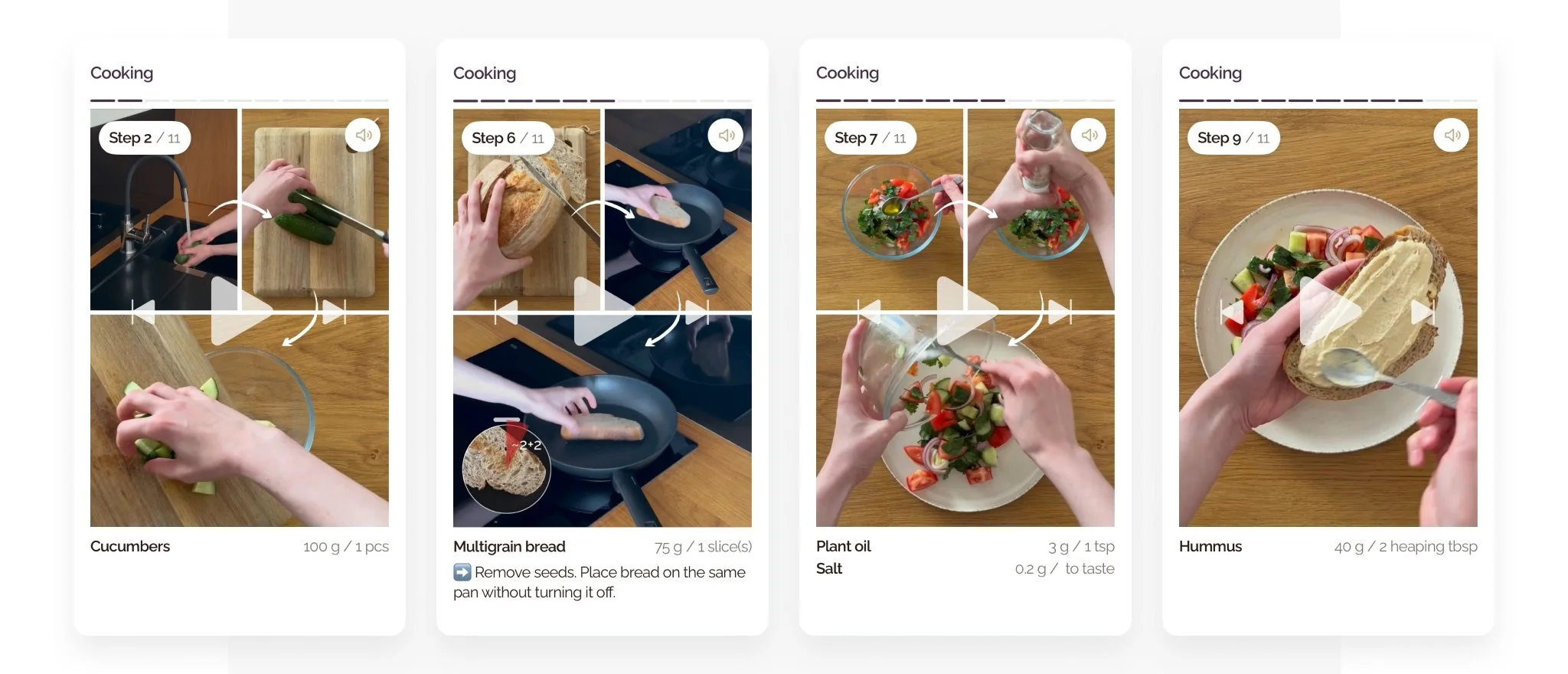
Every recipe step in Plezha is a few seconds long video. No talking. No music — just the real sounds of what is happening. These sounds are not atmosphere. They are information.
We do not skip the "obvious" steps — washing, peeling, chopping. These are part of cooking. But we do not make them separate steps either. Everything is packed into one short video. A few frames on one screen, so you understand everything in seconds. The brain works fast, and we do not want to slow it down.
The video loops. Watch it once, watch it again, move on when you are ready. The app does not decide for you.
Each step shows the ingredient you are using right now — name, grams, and the equivalent in tablespoons or pieces — right below the video. No need to switch screens. No need to scroll up to find the ingredient list. Everything is in one place.
A small circle inside the video shows the most important detail for that step — what toasted seeds look like, how the bread should sit in the pan. A number inside the circle tells you how long. Someone who has never cooked looks at the close-up and knows exactly what to do. Someone who already knows how to cook glances at the number and moves on. One frame works for both.
A progress bar at the top shows where you are — not just inside the step, but in the whole recipe. Step 6 of 11. You always know how much is left.
From a real kitchen
Victor was the first person to cook every recipe in Plezha. An engineer, a game designer — someone with almost no experience in the kitchen and very little patience for things that waste time.
Victor said the video instructions were clear even for someone who had never cooked before. He cooked 18 recipes — and came back for more.
That is what the player is for. And that is why there is no voiceover, no background music, no autoplay to the next step, no ads inside the video.
Your kitchen already has its own rhythm. We are here to help quietly, not to interrupt or show ads.
Every recipe in Plezha uses the same player. Open any recipe in the app — the format is the same. This is intentional. Familiar things take less effort. And taking away effort is the whole point.